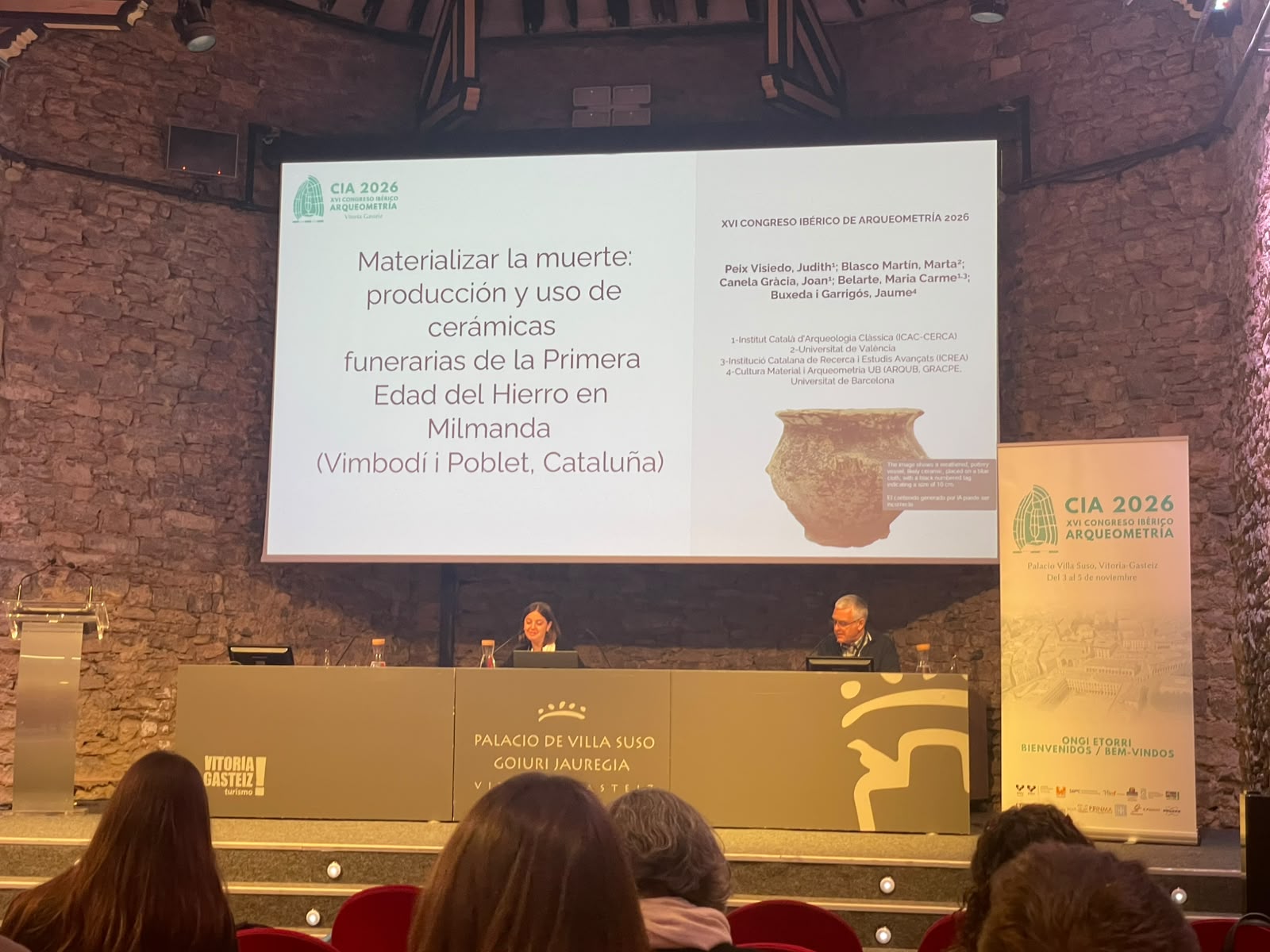
Judith Peix presented the results of the archaeometric study of the cinerary urns from Milmanda, while Àlex Vallespí presented research on the production and circulation of Roman amphorae in the Camp de Tarragona region
On 3, 4 and 5 November, postdoctoral researcher at the Catalan Institute of Classical Archaeology (ICAC) Judith Peix Visiedo and Àlex Vallespí Pinilla, a former student of the interuniversity Master’s Degree in Applied Classical Archaeology (MACA) and a predoctoral researcher at the University of Barcelona, took part in the 16th Iberian Congress of Archaeometry, held at the University of the Basque Country in Vitoria-Gasteiz. Both presented the results of their research on the archaeometric characterisation of ceramic materials.
Judith Peix delivered an oral presentation on the results of the archaeometric study of the cinerary urns from the Milmanda site (Vimbodí i Poblet), where the ICAC’s Protohistoric Archaeology team conducts excavations under the direction of Dr Joan Canela (ICAC) and Dr Marta Blasco (University of Valencia).
The results of the study made it possible to identify several chemical groups among the urns, providing evidence of the local circulation of these vessels. The analysis also made it possible to establish geological links between some of the vessels and the immediate surroundings of Milmanda, as well as to identify two possible imports. The research was funded through a grant from the Palarq Foundation.
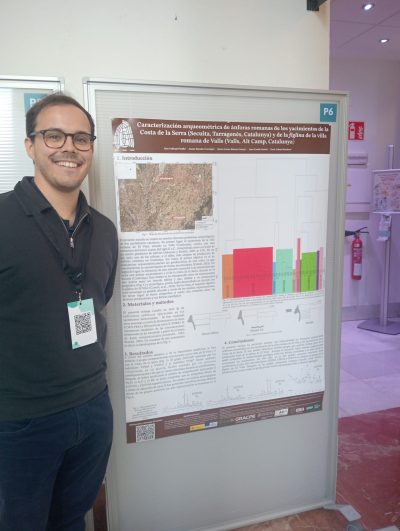 Àlex Vallespí, in turn, presented a poster featuring expanded results from his Master’s Thesis, entitled Archaeometric characterisation of amphorae from the Costa de la Serra site (la Secuita, Tarragonès) and the Valls figlina (Valls, Alt Camp). The thesis was supervised by Joan Canela and Enric Colom, researchers affiliated with the ICAC.
The poster, also co-authored by Jaume Buxeda i Garrigós, Maria Carme Belarte Franco, Joan Canela Gràcia and Enric Colom Mendoza, provided further insight into the production and circulation of Roman amphorae in the Camp de Tarragona region during the earliest stages of amphora production in the Iberian Peninsula.
The research was based on the archaeometric characterisation of amphorae from two archaeological sites: Costa de la Serra (la Secuita), a fortified residence built in the mid-2nd century BC, and the figlina (pottery workshop) of the Roman villa of El Vilar (Valls), which may have been one of the earliest production centres for amphorae under Roman rule.
The archaeometric analyses were carried out within the framework of the ICAC’s four-year research programme The territory of western Cessetania in the first millennium BC: from the Late Bronze Age to Romanisation, co-directed by researcher M. Carme Belarte (ICREA-ICAC) and researcher Joan Canela (ICAC). The research also received support from the Department of Culture of the Government of Catalonia and Valls City Council.