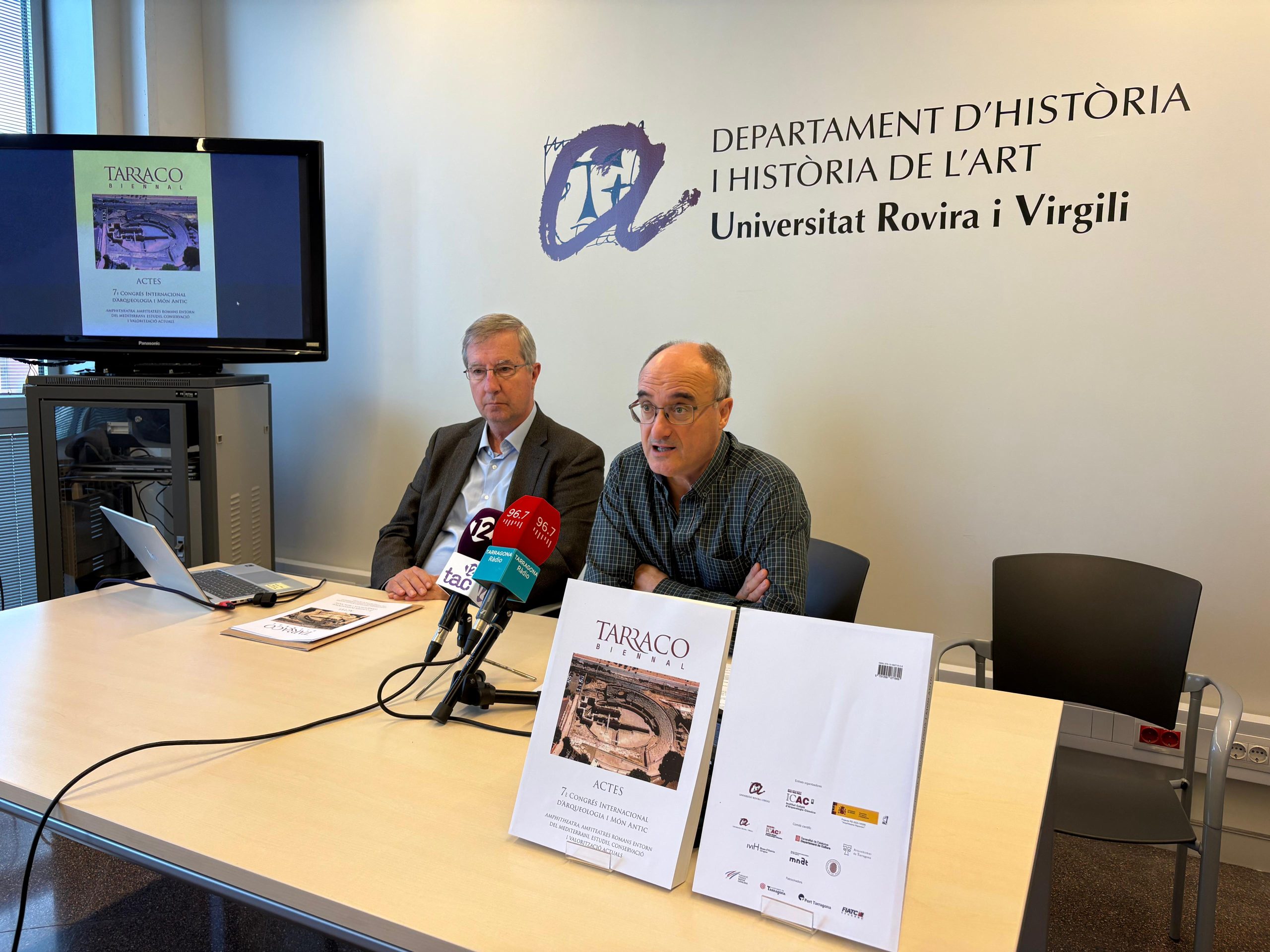
ICAC director Josep Maria Palet takes over the coordination of the scientific committee after fourteen years under the leadership of Joaquin Ruiz de Arbulo. The eighth edition of the International Congress on Archaeology and the Ancient World will take place in Tarragona on 18 and 19 November 2027
The Catalan Institute of Classical Archaeology (ICAC) is taking on a new responsibility in the organisation of Tarraco Biennal. Dr Josep Maria Palet, director of the Institute, succeeds Dr Joaquin Ruiz de Arbulo, Professor of Archaeology at the Universitat Rovira i Virgili (URV) and researcher at the ICAC, as coordinator of the scientific committee of the International Congress on Archaeology and the Ancient World, following fourteen years of the initiative’s development.
The aim is to maintain the same format, with the objective of establishing Tarragona as an international reference point for archaeological research.
This handover marks the beginning of a new chapter for Tarraco Biennal, which will retain its biennial format and its commitment to publishing the proceedings of each congress the following year. Overall coordination and coordination of the scientific committee will be linked to the ICAC’s directorate, while the scientific coordination of each edition will be adapted to its specific theme and the specialists leading it.
Palet has emphasised the importance of ensuring continuity for the project while maintaining its international ambition. In this regard, he highlighted the role that the ICAC has historically played in the different editions and the opportunity this new chapter represents to strengthen Tarragona’s scientific profile internationally.
Tàrraco, territory and landscape: the theme of the 2027 congress
The first edition of this new chapter will be the 8th Tarraco Biennal. International Congress on Archaeology and the Ancient World, which will take place in Tarragona on 18 and 19 November 2027. Its scientific coordination will be led by Dr Josep Maria Palet, Dr Marta Flórez and Dr Arnau Carbonell, researchers at the ICAC.
 Under the title Tàrraco, Territory and Landscape and the motto Tàrraco, beyond Tarragona, the congress will offer an interdisciplinary reflection on the influence of the Roman city on the organisation and transformation of its surrounding territory, as well as the lasting imprint this territorial development has left on historical landscapes up to the present day.
The meeting will explore the relationship between the ancient city and its territorial reach, the transformation and structuring of the landscape, and the heritage recognition and enhancement of historic Mediterranean landscapes. Particular attention will be paid to the landscapes of Camp de Tarragona and Penedès, given their cultural and heritage value.
In this regard, Palet has highlighted the heritage and social value of territorial features that often go unnoticed, such as the network of rural roads, many of which date back to Roman times. These elements bear witness to the historical continuity of the landscape and can also become valuable resources for improving connectivity between municipalities, supporting territorial management and promoting sustainable development.
The congress therefore aims to go beyond the study of the ancient city and highlight how archaeological research can contribute to understanding, preserving and enhancing Mediterranean cultural landscapes, with a strong commitment to knowledge transfer and social impact.
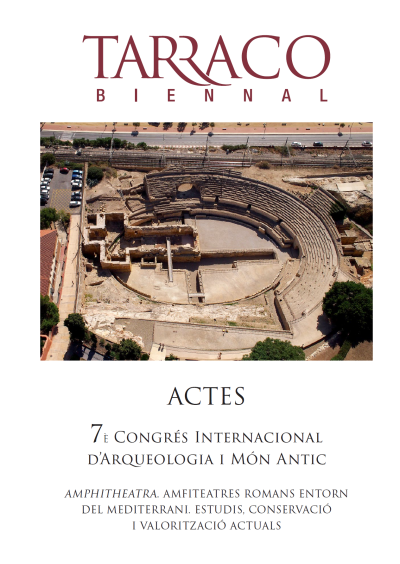 Proceedings of the seventh congress, dedicated to Roman amphitheatres
Alongside the presentation of this new chapter, the proceedings of the 7th Tarraco Biennal will be presented on Thursday 26 November, at 7 pm, at the auditorium of the Generalitat’s Territorial Department of Culture in Tarragona. The congress, held in November 2025, was dedicated to Roman Amphitheatres around the Mediterranean: Current Research, Conservation and Heritage Enhancement.
Edited by Joaquin Ruiz de Arbulo, the publication brings together contributions from the researchers who took part in that edition and explores the role and evolution of amphitheatres as venues for public spectacles, examples of public architecture and sites of historical memory.
Since its launch in 2012, Tarraco Biennal has held seven international congresses, featuring 214 scientific papers and bringing together more than 450 academics and professionals from around the world. The initiative is now entering a new chapter, with the ICAC taking the lead in its coordination.