• Contacte
  • Intranet
  • CAT
  • ES
  • EN

ICAC

Institut Català d'Arqueologia Clàssica

  • Qui som
    Investigadors en arqueologia
    • Salutació del director
    • Institució
    • Organització
    • Personal
    • Memòries
    • Convenis
    • Igualtat
    • Presència institucional
    • Excel·lència en RH
    • Treballar a l’ICAC
    • Portal de la transparència
    • Protecció de dades
    • Perfil del contractant
    • Facturació electrònica
    • Contacte
  • Recerca
    Generem coneixement
    • Grups de recerca
    • Personal investigador
    • Projectes
    • Publicacions científiques
    • Laboratoris
    • Ciència oberta
    • Tesis doctorals
    • Accions MSC
  • Formació
    Arqueòlegs de demà
    • Màster en Arqueologia Clàssica Aplicada
    • Doctorat interuniversitari en Arqueologia Clàssica
    • Altres programes
  • Difusió
    Connexió amb la societat
    • Activitats de l’ICAC
    • Activitats dels investigadors
    • Transferència del coneixement
    • Toquem Pedra
    • Patrimoni en 3D
    • Diaris de Campanya
  • Serveis
    Eines i suport a la recerca
    • Centre de documentació i Biblioteca
    • Unitat d’Estudis Arqueomètrics
    • Servei de publicacions
    • Plataformes científiques
    • Unitat de Transferència i Impacte Social
  • Actualitat
    Què hi ha
    de nou?
    • Notícies
    • Agenda
    • Butlletí Archeonea
    • Premsa
    • Subscripció

Notícies

/ Actualitat / Notícies / Uncategorized @ca

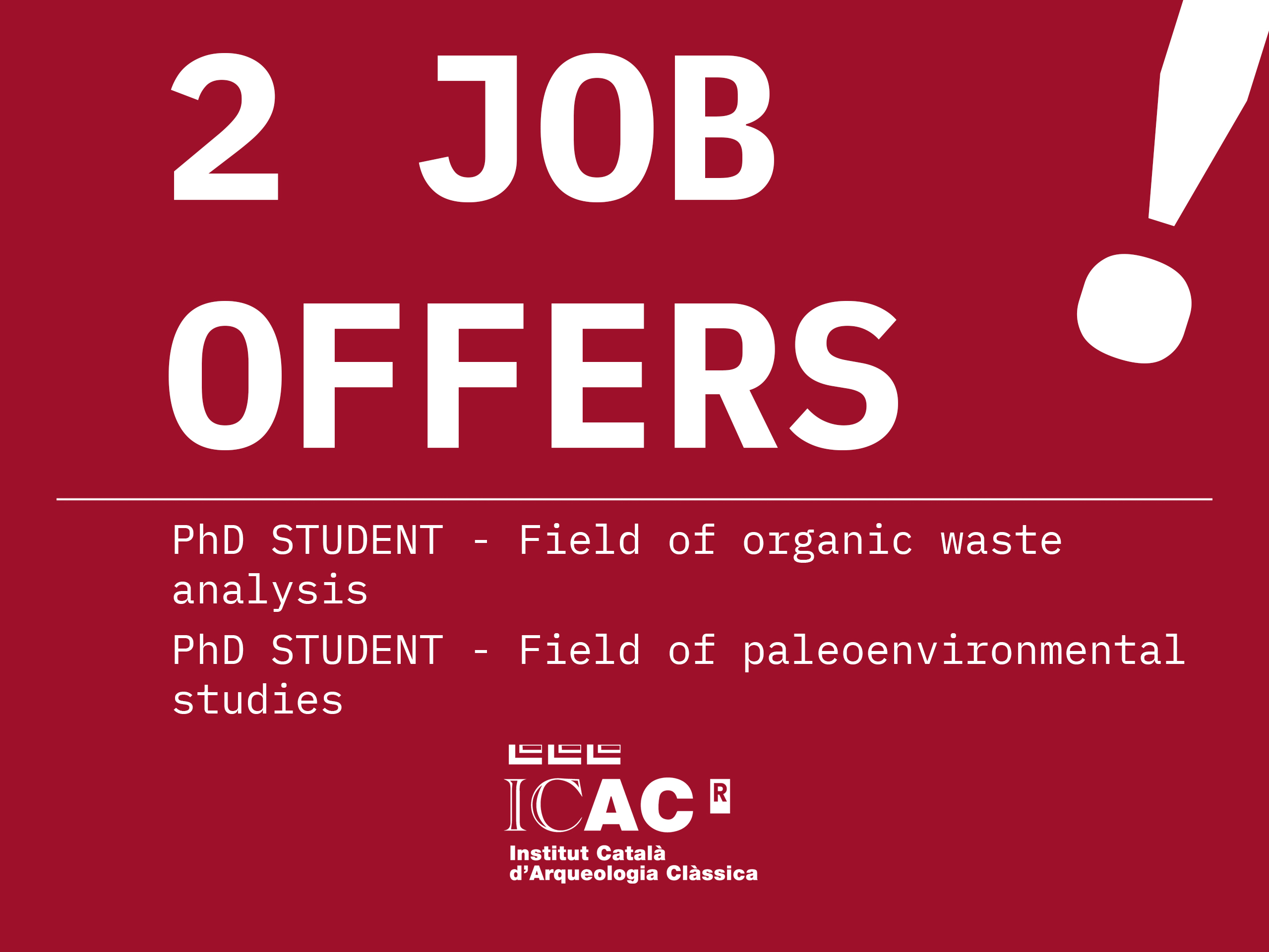
Open call for two 4-year fully funded PhD positions

20 març 2026

We are pleased to announce an open call for two 4-year fully funded PhD positions, one in Mediterranean Holocene Paleoenvironments (MEDLAND project) and another in Organic residue analyses on Roman Iberian ceramics (BIOEAT project).


The candidate of the BIOEAT project will reconstruct Roman eating habits, through the analyses of organic substances (fats from adipose tissue, dairy products, marine and freshwater products) in cooking pots and vessels from Catalonian urban and rural sites. This work integrates biochemical data with archaeozoological and Roman written sources evidence to investigate the contribution of animal products to the everyday dietary habits of the Roman inhabitants.

Key details:
  • Research & Training: ICAC and URV
  • Funding: 4-year contract starting May 2026.
  • Interdisciplinary mentorship in Organic residue analyses and Roman archaeology by GIAP-ICAC and Faculty of Ethnology of the URV

⇒ Application deadline: 25 March 2026 (23:59 CET).


The candidate of the MEDLANDS project will investigate Holocene landscapes in coastal Thrace, Greece, through a multi-proxy palaeoecological approach—including pollen, non-pollen palynomorphs (NPPs), and microcharcoal. This work integrates palaeoenvironmental data with archaeological and geoarchaeological evidence to explore vegetation and landscape changes linked to prehistoric and colonial settlement dynamics, particularly near the ancient Greek colony of Abdera.


Key details:
  • International Mobility: 2 years at ISEM (France) followed by 2 years at ICAC (Spain).
  • Research & Training: Fieldwork (sediment coring) in Greece and advanced laboratory training in palynology.
  • Funding: 4-year contract starting June–September 2026.
  • Interdiciplinary mentorship in palaeoenvironmental research and landscape archaeology by ArqueoPal-ISEM and GIAP-ICAC.

⇒ Application deadline: 15 April 2026 (23:59 CET).


Full details of the application process in the official calls



COMPARTEIX:
Imprimir PDF
« ‘Food taboos in archaeology’ – another CUP Elements out and free to download until 24th of March

Actualitat

  • Notícies
  • Agenda
  • Butlletí Archeonea
    • Històric Archeonea
  • Premsa
  • Subscripció
Consorci integrat per:
Centre CERCA:
Centre acreditat:
Plaça d’en Rovellat, s/n, 43003 Tarragona
Telèfon: 977 24 91 33 · info@icac.cat
© 2026 ICAC · Avís legal · Política de cookies
Aquesta web és al PADICAT
Utilitzem cookies per garantir que us donem la millor experiència al nostre lloc web. Si continueu utilitzant aquest lloc, assumirem que us plau.